Furniture Movers in {{area.main}}
{{business.name}} moves furniture across {{area.alt}} — one piece or a room's worth. A couch bought from a private seller, a dresser inherited from family, a delivery that was left in the driveway, or a wardrobe that needs to go up a flight of stairs in your own house. Tell us what the item is, where it's coming from, and where it's going.
What a furniture move covers
A single item between two addresses
The most common request there is.
Collections from a private seller, a store, an auction, or an estate sale
Marketplace pickups, warehouse collections, and lots that have to be cleared by a deadline.
A few pieces rather than a household
Furnishing a first apartment, or taking three things and leaving the rest.
Moving something within your own home
Up or down stairs, room to room, basement to bedroom.
Clearing and resetting rooms
For flooring, painting, or staging a house for sale.
Furniture only
When the boxes are going separately.
Anything larger than that is a local move or an apartment move rather than a furniture move.
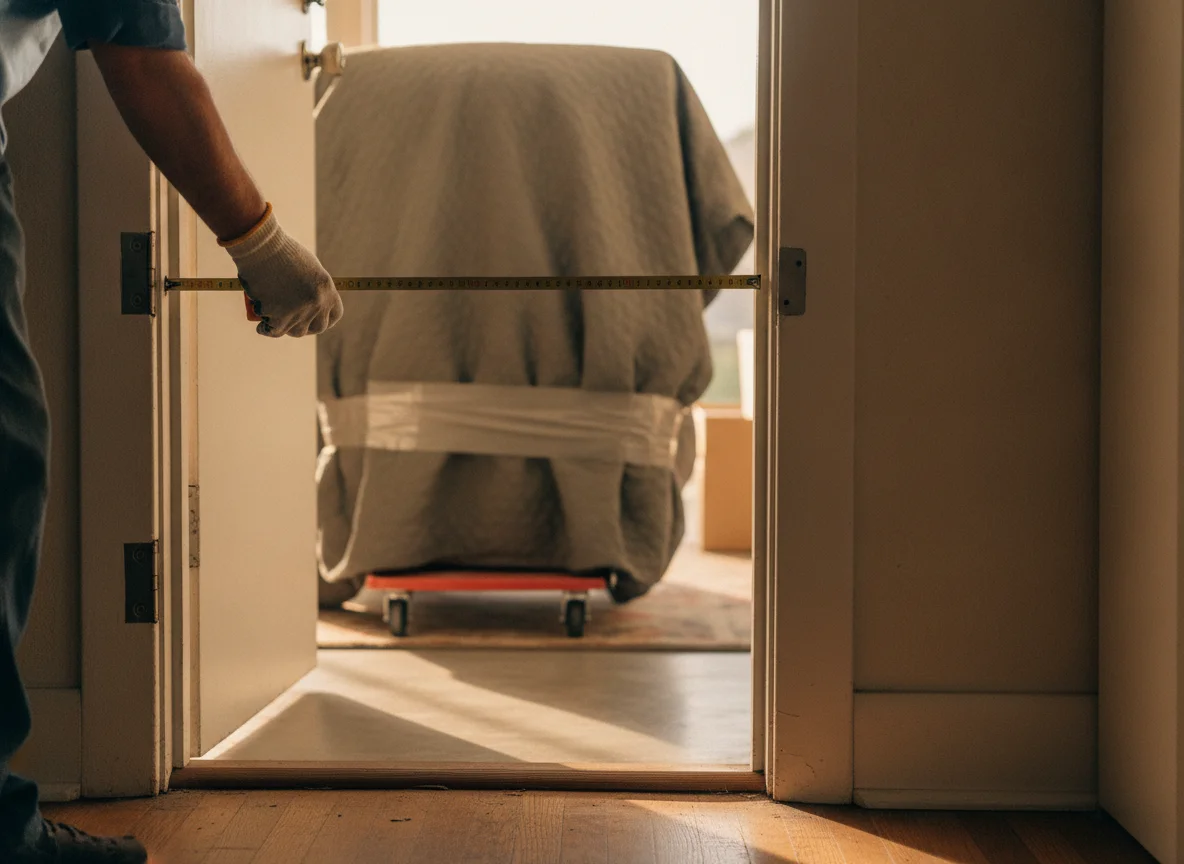
Buying secondhand? Measure before you commit.
The single most useful thing on this page: measure before you buy, not after. Private sellers don't take returns, and a sofa that won't clear your stairwell is your problem the moment money changes hands.
Measure three things: the piece itself at its widest and deepest, your entrance door and any interior door it has to pass, and the turn — the top of the stairs, the corner of a hallway, the half-landing. The turn is what defeats furniture far more often than the doorway does, because a long piece needs room to pivot as well as room to pass.
While you're asking the seller questions, ask which floor it's on, whether it comes apart, and whether it's currently against a wall or somewhere it has to be dragged out of first.
The seller's address and a contact number, plus a window when somebody will actually be there
Which floor it's on, at their end and at yours
Rough dimensions, and whether the piece is already apart or needs dismantling
Whether the seller has help available, or whether the crew is doing all of it
What the route looks like at your end — stairs, turns, the door it has to come through
Item by item, what actually catches people out
Sofas and sectionals.
A sectional separates into pieces and is usually the easy one. A one-piece sofa gets pivoted through a doorway on its end, and if the arms are fixed and the turn is tight, sometimes it simply doesn't go — which is why the measuring matters.
Recliners.
The backs come off most of them, which is the difference between fitting and not fitting. Powered recliners have a cable and a transformer that need disconnecting properly and keeping with the chair.
Dressers and chests.
Emptied, always. Drawers stay in for solid pieces and come out for anything flimsy, and either way the drawers get secured so they can't run out on a set of stairs.
Armoires and large wardrobes.
Top-heavy, awkward to control on a turn, and frequently assembled inside the room they're standing in.
Glass-fronted cabinets and display units.
Shelves out and packed separately, doors secured, glass protected before anything is lifted. Interior glass shelves are the most commonly broken part of any cabinet.
Dining tables.
Legs off, top carried and transported on edge rather than flat.
Bed frames.
Hardware bagged and tied to the frame it came from. A slat kit with no bolts is a bed you can't rebuild.
Treadmills and home gym equipment.
Heavy, unbalanced, and often needing folding and locking before they move at all. Weight stacks come apart.
Aquariums.
Completely drained and emptied first, with rock, substrate, and water out. A tank with water still in it is glass under load and it will fail — a partially full tank is not a shortcut.
Grandfather clocks.
The pendulum and weights come out and the movement gets secured before the case is tipped at all. This is the item most often damaged by being treated as ordinary furniture.
Antiques and older pieces
Older furniture needs different handling, not just gentler handling:
Don't shrink-wrap plastic directly onto an old finish or onto leather.
It traps moisture against the surface and can lift or cloud a finish over even a short trip. Blankets go on first, plastic only over the top of them if it's needed at all.
Old joints are loose joints.
A period chair picked up by its arms, or a table lifted by its top, puts all the load through glue that may be a century old. These get carried by their frames, low down.
Veneer lifts
Where a modern surface would just scuff, so edges and corners get padded rather than relying on the piece being sturdy.
If a piece is genuinely valuable, say so before the day and ask how protection works for a single high-value item — it's a different conversation from a whole-house shipment.
Pieces that need planning, not surprise
Pianos, large safes, pool tables, oversized aquariums, and grandfather clocks are all movable, but not as an afterthought on the morning. Each needs the right approach and enough people, and a pool table in particular travels in sections and has to be slate-leveled again once it's set up, which is a job in itself. Mention any of these when you first get in touch and they're straightforward. Mention them on the day and they're a problem.
When the delivery stopped at the door
Plenty of retail deliveries end at the threshold, the garage, or the curb — which is fine until the box weighs more than you do and the bedroom is upstairs.
Getting a delivered item inside, up the stairs, unboxed, put where you want it, and the packaging taken away afterward is a normal furniture-move booking. So is the same job for something that arrived while you were out and has been sitting in the driveway since.
What affects the price
The size and weight of the piece, how many flights of stairs are involved at each end, how far apart the two addresses are, whether anything has to be dismantled and rebuilt, whether there's help available at the collection end, and how much notice there is. A tight turnaround costs more than a flexible one; where the deadline is the whole problem, same-day moving covers it.
We cover {{area.full}}.
Common questions
Will you move just one thing?
Yes. Single items are most of what this service is, and there's no minimum number of pieces you have to reach before it's worth asking.
Can you collect from a private seller I've never met?
Routinely. Give us the seller's address, a contact number, and a window when they'll be home, and confirm with them that someone will be there — a collection that arrives to a locked house is the one thing that reliably goes wrong.
Can you move something inside my house without moving me?
Yes — upstairs, downstairs, room to room, or everything out of a room and back in once the floor is done. If it's several rooms' worth, loading and unloading help is usually the better way to book it.
Will you put flat-pack furniture together?
Anything taken apart to get it out gets rebuilt at the other end. Assembling brand-new furniture from a flat box is a different job, so ask rather than assume — and be aware that particleboard that has already been assembled once rarely survives being taken apart and rebuilt.
Ready to move a piece?
Send what the item is, roughly how big it is, the address it's coming from and the one it's going to, which floor each end is on, and when you'd like it done. A photo helps more than a paragraph.