Residential Movers in {{area.main}}
{{business.name}} moves homes across {{area.alt}} — a one-bedroom rental, a four-bedroom family house, or anything in between. The whole house, room by room, including the garage and the attic that most people forget until the last weekend. Furniture wrapped, taken apart where it has to be, and put back together in the rooms you want it in. Send us your addresses and your date to get started.
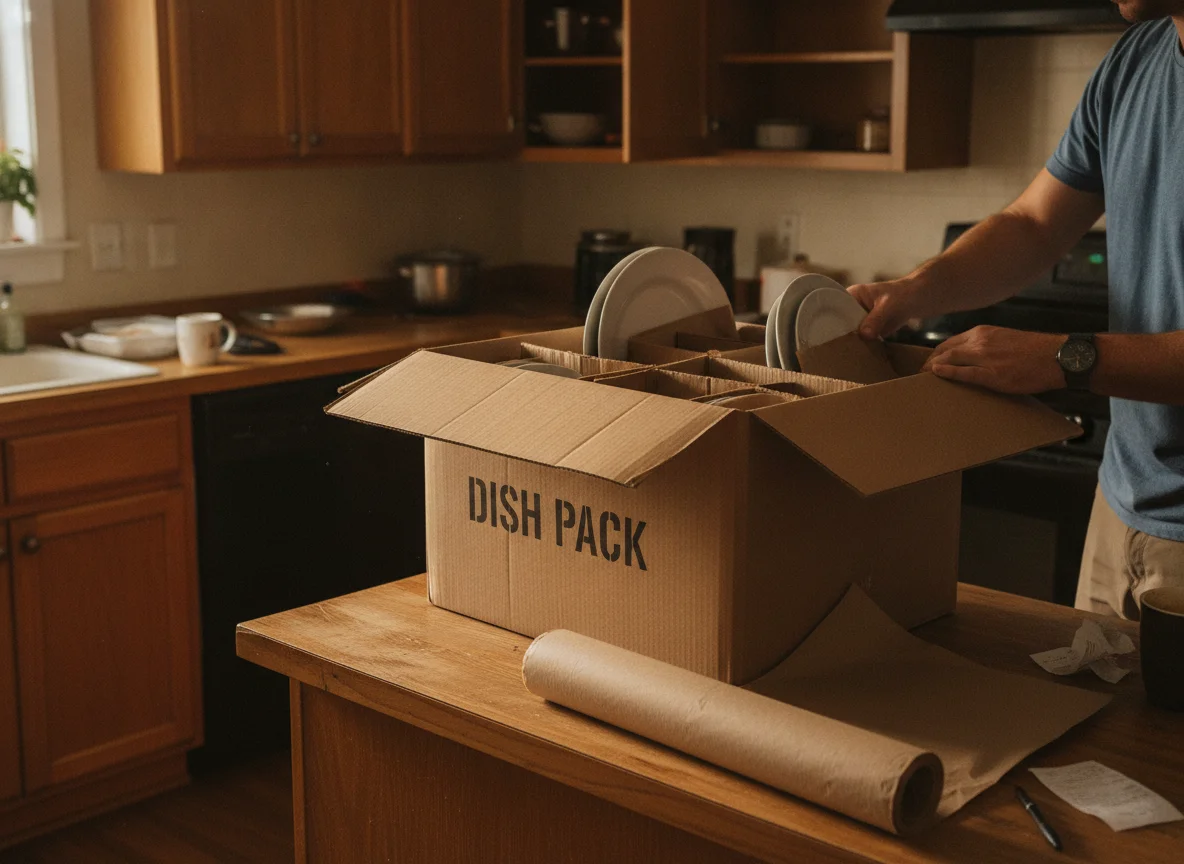
A whole-house move, room by room
This is where a house move differs from every other kind. It isn't one job — it's eight or nine small ones with very different problems:
The kitchen
Is the slowest room in any house, and it's what usually decides the schedule. Glass and ceramics go in dish packs with cell dividers, not wrapped in newspaper and stacked. The pantry has to be sorted rather than boxed wholesale — open bottles, anything that leaks, anything past its date. Small appliances need their own cords and parts kept with them. The fridge gets defrosted the night before and its water and icemaker lines disconnected and drained.
Bedrooms
Come apart faster than people expect and go back together slower. Beds get broken down and the fittings bagged and labeled to the frame they came off. Hanging clothes go straight from the closet into wardrobe boxes and straight back out at the other end, still on their hangers — it saves hours and a great deal of ironing. Master closets are always bigger than they look.
Kids' rooms
Are packed last and unpacked first. Keep one box of the things that matter most to them with you rather than on the truck, and make the bed up at the new house before anything else gets touched.
The living room
Is where measuring matters. Sofas and sectionals get checked against the doorway before they're lifted, TVs travel upright in purpose-made cartons, and wall brackets stay on the wall unless an electrician is taking them down along with the wiring behind them.
The home office
Needs photographs of the cabling before anything is unplugged. Hard drives, backups, and anything you can't re-download travel in your own car.
Bathrooms
Are small but leak-prone. Liquids double-bagged, upright, and in their own box rather than mixed in with towels.
The garage, basement, shed, and attic
Are the single biggest underestimate in any house move. Start here, not last. Fuel-powered equipment has to be drained, paint and chemicals sorted out before the day, and the loft emptied while there's still time to decide what's worth taking. More houses run late because of the garage than because of the furniture.
Outside
Patio sets, grills, planters, and playsets all need dismantling time, and the propane tank off the grill isn't going on the truck at all.
What stays with the house
Worth settling early, because it causes more disputes on closing day than anything else. Built-in appliances, light fixtures, ceiling fans, window treatments, shelving anchored to the walls, and TV wall brackets are usually treated as part of the property rather than as your belongings — but "usually" isn't a contract. Check what's actually written into your sale or lease agreement, and tell us what's going and what's staying before the day. Anything ambiguous is better resolved with the other party a week out than with a crew standing in the hallway.
Planning around your closing or lease date
Keys handed over at both ends on the same day is the plan everyone hopes for and few people get. The gap goes one of two ways, and both are manageable if you flag them early:
A gap between moving out and moving in.
The shipment goes into storage between the two dates rather than sitting on a truck, and you live out of a suitcase in the meantime.
An overlap.
The easier version — move over two days, get the beds and the kitchen in first, and come back for the garage.
Either way, tell us as soon as you know the dates might not line up. A planned gap is a straightforward piece of scheduling. An unplanned one, discovered on the morning, is not.
The day itself, with a family in the house
Arrange for kids and pets to be somewhere else for the day if you possibly can, and behind a closed door if you can't. Open front doors, propped gates, and heavy things moving through narrow spaces are a bad combination for both.
Pack an essentials box that travels in your car: bedding, towels, toiletries, phone chargers, medication, coffee, a change of clothes, and the paperwork for the move.
Have someone at the new address who can say which room each thing goes in. Decisions made at the door are much cheaper than furniture moved twice.
Feed people. A house move takes longer than anyone plans for and nobody thinks about lunch until it's too late.
What moves the price
How much you're taking, how much of it has to be dismantled, how much packing you've already done, and — usually the largest factor of the four — how hard your house is to get things out of. Stairs, a long walk to the curb, a driveway a truck can't use, and doorways that force furniture apart all count for more than square footage does. The local moving page goes through that in detail, and it's worth reading before you start comparing quotes.
If your move is going to another state, the picture changes quite a lot: see long distance moving.
How your things are protected
Beyond the wrapping and padding that goes on every job, a house move has its own kit:
Wardrobe boxes
So hanging clothes never come off the hanger.
Dish packs with cell dividers
For glass and ceramics, which survive stacking in a way that newspaper-wrapped plates do not.
Mirror and picture cartons
For framed art, mirrors, and glass tops, carried on edge.
Mattress bags
So nothing gets marked on a stair wall or a driveway.
Appliance dollies and straps
For the washer, dryer, and fridge, with the washer's transit bolts refitted before it moves so the drum can't beat against the cabinet.
Floor runners, door jamb padding, and banister wrap
At both addresses, because most of the damage in a house move happens to the house rather than the furniture.
We cover {{area.full}}.
Common questions
Do you move appliances?
The washer, dryer, and fridge, yes. Anything running on gas or wired into the house has to be disconnected beforehand by the relevant licensed trade, and reconnected by them at the other end — that work sits outside what a moving crew does, so book it separately and early. If your appliances are staying with the house, say so up front and they won't get wrapped by mistake.
What if my closing date moves?
Tell us the moment you know. Dates slipping is normal in a property chain and it's a scheduling problem, not a crisis — but it's a much smaller problem the week before than the night before.
Can we move over two days instead of one?
Often the better plan for a larger house, particularly when you have access to both addresses at once. Beds, the kitchen, and the kids' rooms go first so the house is livable that night; the garage, the attic, and the storage rooms follow.
How long should I allow for packing?
Longer than you think, and the two rooms that overrun are always the kitchen and the garage. If you'd rather not do it at all, packing services covers the whole house or just the rooms you'd rather hand over — the kitchen alone is the one most people hand off.
Do you move businesses too?
Yes, though an office move is planned differently and usually runs outside trading hours — see commercial moving.
Ready to move house?
Tell us where you're moving from and to, how many bedrooms are coming, when you need it done, and whether your dates are firm yet. Mention anything oversized, fragile, or awkward while you're at it. That's enough to get started.