Local Movers in {{area.main}}
{{business.name}} moves households and small offices across {{area.alt}}. Crews pad and wrap your furniture, take apart what has to come apart, load, drive, unload, and put everything back together in the room you want it in. Local means the move stays inside the state — across town, or out to a nearby community. Send us your two addresses and your date and we'll take it from there.
What we move
Find your job in this list:
A whole house or condo
Every room, plus the garage, attic, basement, and shed.
An apartment
Including buildings with shared entrances and stairwells, covered in more detail on the apartment moving page.
A single room
A bedroom out to college, a home office, a nursery.
A small office or storefront
Desks, filing, shelving, and IT, usually outside trading hours.
Into or out of storage
Either end of the trip, or both.
One heavy item
A sofa, a gun safe, a treadmill, an armoire. That's a furniture move rather than a house move.
Around the house
Everything out of two rooms and back in again while floors go down.
If your move crosses a state line, you want long-distance moving instead — those are quoted and scheduled differently.
What we do so nothing gets wrecked
Almost all moving damage is a small number of predictable mistakes. Here's what's done to avoid each of them:
Floors, doorways, and banisters get covered before anything is carried.
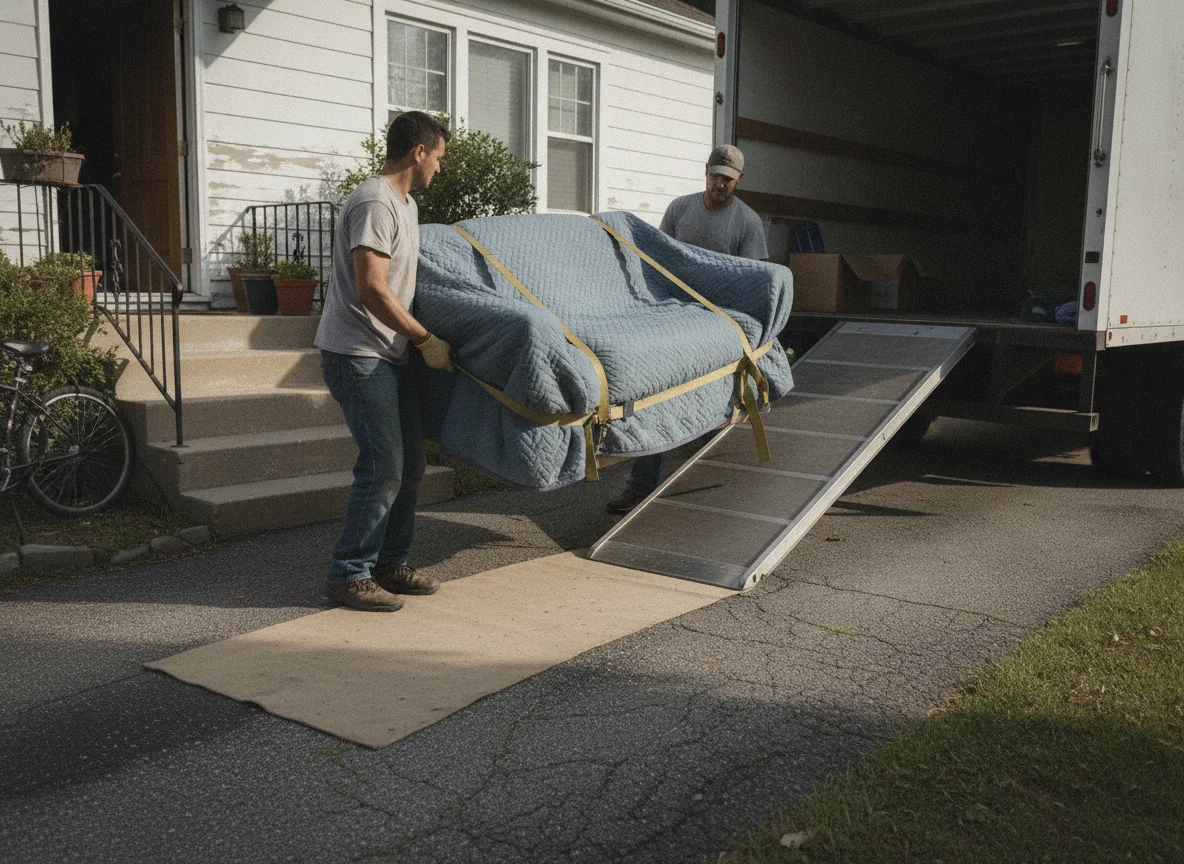
Runners on carpet and traffic paths, padding on door jambs, wrap on stair rails. Most of the damage in a move happens to the house, not the furniture.
Everything soft-sided is pad-wrapped, not just stacked.
Blankets first, then secured, then loaded — arms and corners are where a sofa gets scuffed.
Flat-pack furniture stays assembled wherever a doorway allows.
Particleboard doesn't survive a second bite: cam locks and dowel holes are chewed the first time a piece comes apart, and a wardrobe that gets stripped down often never sits square again.
Stone and glass tops travel on edge, in an upright frame.
A stone slab has almost no strength across its face, and one carried flat can crack under its own weight over a single bump.
Sleeper sofa mechanisms get strapped before the sofa is tilted.
An unstrapped one swings open in the doorway and takes the frame, the door casing, or someone's shin with it.
Big pieces get measured before they're lifted, not halfway up the stairs.
The item that fits the room may not fit the half-landing, and that's better known at the bottom.
Mattresses go in bags.
A bare mattress dragged along a stair wall or set down in a driveway picks up marks that don't come out.
Washer transit bolts go back in.
The drum hangs on springs, and without the bolts it beats itself against the cabinet on the drive. Supply lines, drain hose, and the fridge icemaker line all get disconnected and drained so nothing leaks into the load.
TVs ride upright in a purpose-made carton.
Never laid flat with anything on top of the panel.
At the other end everything comes off by the room label on the carton, and beds and tables go back together before the crew leaves.
What moves the price
Two homes with identical furniture can be very different jobs, and it's usually not the amount of stuff. What matters most:
Access at both ends. The distance and difficulty between your front door and where the truck can actually park. Stairs at either address, a long walk from the door to the curb, a narrow lane, a steep or soft driveway, a gate a truck won't fit through, cars parked down both sides of the street. Every one of those gets repeated on every trip in and out of the house.
How much has to come apart. Beds, tables, shelving, and anything that won't clear a doorway assembled.
How much of the packing you've done. Cartons sealed and labeled before the day versus a kitchen still to be wrapped are very different jobs.
Timing. Month-end and the summer weeks are when everyone moves, and the calendar fills from there first.
Anyone quoting a house move properly wants to see what they're quoting — either a walkthrough or a video call. Be careful with a number given over the phone by someone who hasn't looked; that's the number most likely to change on the day.
What to have ready when you get in touch
Nothing formal. Just:
Both addresses, and what floor each one is on
Your date, and whether it can flex
Roughly what's coming — number of bedrooms is usually enough
Anything oversized, fragile, or awkward: a piano, a safe, a pool table, a large aquarium, a marble table
Whether you're packing yourself or want packing services handled for you
That's enough to size the job.
Short notice is worth asking about rather than assuming — see same-day moving.
Contact UsWhen you need less than a full move
Worth saying plainly, because it saves you money:
A studio or one-bedroom on the ground floor, nothing to disassemble, and a truck or container already in your driveway?
Loading and unloading help is the right size of job — the truck stays yours, and a crew packs it properly so nothing shifts on the drive.
A few boxes and nothing large?
That isn't a moving job, and no one is served by pretending it is.
Some things won't go on the truck at all.
Propane tanks, gasoline, paint thinner, aerosols, pool chemicals, ammunition, and fireworks don't travel on a moving truck. Mowers, generators, and trimmers go only with the tank drained and the plug pulled.
Gas appliances and hard-wired appliances
Need the relevant licensed trade to disconnect and reconnect them. The crew moves the appliance; it doesn't touch the gas line or the wiring.
Keep the irreplaceable with you.
Documents, medication, jewelry, keys, laptops, and anything sentimental ride in your own car. So do pets, and so do live plants over any real distance.
Getting ready for moving day
Cartons closed, taped, and labeled with the room they're going to. Books in small cartons rather than large ones — a large box of books is a box nobody can lift safely. Drawers emptied of liquids and anything breakable. Freezer defrosted the night before. A parking space cleared in front of the house. Kids and pets shut in one room with the door closed, rather than loose in a house with a ramp running through it.
We cover {{area.full}}.
Common questions
How far ahead should I book?
As soon as you have a firm date. Month-ends, the last week of the month, and the summer are the busiest windows, and those dates go first — if your date sits in one of them, it's worth getting in touch well before you're ready to pack.
What happens if something gets damaged?
Ask any mover you're considering what protection applies to your shipment, what it's based on, and what the upgraded option covers, before you agree to anything. It's a fair question, the answer varies more than people expect, and a mover who's straight with you about it is telling you something useful.
Do I need to be there on the day?
Yes, or someone you trust to make decisions on your behalf. There are always calls to make — what goes on the truck last, which room a piece ends up in, what's staying behind — and they go better with you there.
Can you move a piano, a safe, or a pool table?
Tell us before the day rather than on it. Those need specific equipment and enough people, and a pool table has to be broken down and re-leveled properly at the other end. All of it is doable when it's planned; none of it is a surprise anyone wants at 8am.
Ready to move?
Send both addresses, the floor each one is on, your date, and roughly what's coming. That's all it takes to get started.